Strengthening the Movement to End Slavery
- Dec 3, 2025
- 6 min read
Updated: Dec 3, 2025
On 2 December, the International Day for the Abolition of Slavery, we stop to remember a hard truth: slavery did not end with abolition laws or the transatlantic slave trade. It changed shape.
Today, the UN estimates that around 50 million people are trapped in contemporary forms of slavery – in forced labour, forced marriage, trafficking and other forms of extreme exploitation. That is roughly one in every 150 people on earth. Behind every one of those numbers is a life stolen: a child stitching clothes in a factory they will never afford to buy from, a woman trapped in a so-called marriage she never consented to, a worker whose passport has been taken and whose wages never appear.
Slavery today: hidden, but not inevitable
The International Day for the Abolition of Slavery focuses on these contemporary forms of slavery: human trafficking, sexual exploitation, forced and child labour, forced marriage and the recruitment of children into armed groups. These abuses are present in every region of the world, often hidden behind respectable fronts: a supply chain, a recruitment agency, a private home, a restaurant, a building site.
Modern slavery thrives where three things come together:
• Vulnerability – poverty, displacement, discrimination or lack of legal protection
• Demand – for ever-cheaper labour, services or goods
• Impunity – when exploiters believe they will not be held to account
Change any of these, and slavery becomes harder to sustain. Change all three, and communities become resilient.
Arise’s belief: frontline communities hold the key
Frontline groups are the first to notice the warning signs: when a girl suddenly disappears from school, when a worker stops receiving their wages, when a new job opportunity sounds too good to be true. Arise exists to strengthen their ability to act. Below is the long-term impact of our work across our core regions.
Our work since we began
India
Since 2016, Arise has facilitated 116 projects, reaching more than 136,000 vulnerable people, and trained over 24,000 anti-slavery actors. Joint programmes with frontline groups support remedial education, skills training, access to state services, awareness sessions, community groups and safe migration pathways for at-risk families. We want to extend support to frontline groups in more remote regions of India that are working to prevent forced marriage, sex trafficking and forced and child labour by providing more accompanied projects, training, network conferences and access to funding.
Albania
As treatment of Albanian victims becomes increasingly harsh and politicised across the continent, it is critical that victims, including those vulnerable to re-trafficking, are supported at source. Arise has provided over 6,818 hours of capacity building and supported 25 anti-trafficking programmes in Albania over six years, directly impacting more than 14,000 at-risk people. We aim to strengthen our partnership with the United Response Against Trafficking Network through grants that sustain shelter facilities, expand survivor reintegration and economic empowerment programmes, and reinforce prevention initiatives addressing root causes.
Nigeria
Since 2021, Arise has implemented 28 grants supporting long-term prevention projects with frontline organisations, focusing on skills training, awareness raising, financial security and capital support. During 2023, we organised nine capacity building and network strengthening trainings with 700 participants representing more than 70 frontline groups. We plan to prioritise entrepreneurship programmes for at-risk young people, include more community leaders in awareness work, focus on specific underserved regions, expand support to National Counter Trafficking in Persons Response and continue growing sustainable frontline capacity across the country.
Philippines
Since 2019, Arise has supported over 10,000 vulnerable people through 14 grants, working with frontline groups to rehabilitate survivors, strengthen community safeguarding mechanisms and raise awareness about the online sexual exploitation of Children. We have also deepened collaboration with the Knights of Columbus, training 90 members across multiple sectors to engage meaningfully in anti-trafficking efforts. We aim to strengthen collaboration across the Philippines anti-trafficking network by training community leaders and frontline staff to prevent labour trafficking and child sexual exploitation across four regions. We plan to renew current projects and expand our grant portfolio to include five additional frontline groups, with a new focus on addressing exploitation in the fishing sector. We will also continue building the capacity of the Knights of Columbus, equipping Brother Knights to act as anti-trafficking ambassadors in their communities.
What we have done this year
Our end-of-year report will be released in the coming weeks, but below are highlights from January to July 2025.
• 84 frontline groups partnered with Arise to further their anti-trafficking work.
• 1,973 youth or community groups were formed, strengthening anti-trafficking networks from the ground up.
• 1,157 people were helped to access their legal rights or received psycho-social support from sisters or frontline project leaders.
These achievements reflect the core of our mission: partnering with frontline groups so that communities themselves become resilient against trafficking.
India – new developments this year
Arise has launched three new projects across Haryana, Assam and Odisha, where sisters are leading creative prevention strategies such as forming community vigilance groups, offering after-school support for at-risk children and running livelihood programmes that create safe and sustainable income opportunities for families vulnerable to trafficking.
Albania – new developments this year
Three new projects supporting survivors of trafficking and abuse have been delivered in Albania, focusing on rehabilitation, psycho-social care, economic reintegration and sustainable employment. One example is Mila, whose journey shows how tailored reintegration combining education, counselling, life skills training and vocational support can help young women build safe, independent futures.
Philippines – new developments this year
An external evaluation of our Philippines Programme found overwhelming support from frontline partners, who praised Arise’s trust-based approach. In response, we have developed a new capacity-building model that brings together groups with shared training needs to strengthen peer learning and improve sector-wide resilience. This year, our Country Coordinator joined local authorities for specialised training on responding to online sexual exploitation of children – a powerful moment that reflected the deep commitment of Philippine partners working on the frontlines of this urgent issue.
Nigeria – new developments this year
A new grant from the Knights of Columbus is enabling Arise to pilot anti-trafficking interventions in internally displaced people’s camps, where more than 3 million Nigerians remain vulnerable to exploitation. Working with three new partners in Benue State and Abuja, these pilots will strengthen camp leadership to identify risks and create effective referral pathways. Our partnership with the Nigerian Conference of Women Religious continues to grow, with sisters delivering trafficking awareness programmes in 621 schools across Lagos and preparing to undertake trauma-informed care training that will expand national expertise in supporting highly vulnerable people.
Our ongoing commitments
At Arise, we remain committed to strengthening frontline action by:
• Supporting locally led projects that prevent trafficking before it happens
• Funding school enrolment, skills training, survivor rehabilitation and access to state services
• Helping frontline leaders organise, share intelligence and coordinate responses
• Amplifying frontline insights so governments, businesses and international bodies listen and act
When a community worker in India intervenes before a child is trafficked, when a sister in Nigeria helps a survivor access justice, when an organisation in Albania has the training and funding to spot and stop exploitation – abolition becomes real.
A day to celebrate – and to commit
The International Day for the Abolition of Slavery is a celebration of resistance and courage across generations. But it is also a call to action in what the UN Secretary-General, António Guterres, describes as a “relentless contemporary crisis” of exploitation.
Today, Arise renews three commitments:
1. To listen to the frontline – those closest to the problem are closest to the solution.
2. To centre survivors’ dignity – freedom is not only release from harm; it is the opportunity to rebuild.
3. To challenge systems, not just symptoms – from unfair migration rules to opaque supply chains.
How you can stand with us today
• Learn and share – Start conversations about the reality of modern slavery.
• Act where you are – In your workplace, school, place of worship, business or local council, ask what is being done to prevent exploitation.
• Support frontline work – By standing with Arise, you help equip local leaders to protect those most at risk and support long-term, dignified solutions for survivors.
Two hundred years after abolition in the UK, slavery should be unthinkable. Yet tens of millions still wake each day in conditions that deny their freedom and dignity. On 2 December, we remember that abolition is not history – it is a task still unfolding. Together, with frontline communities at the centre, we can build a world where slavery truly has no place.
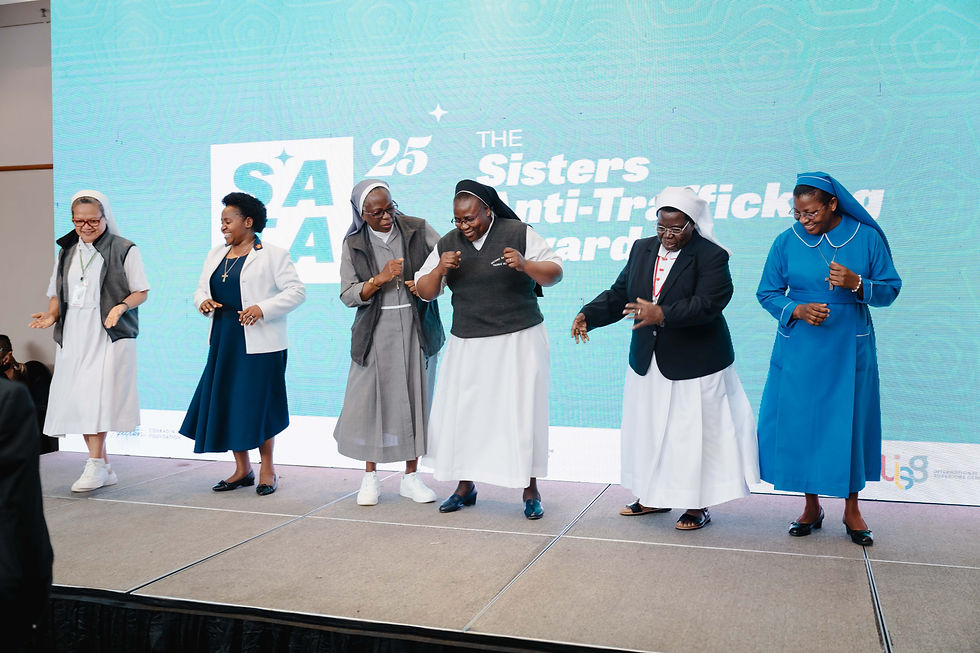
(A moment of celebration captured at this year's Sisters Anti-Trafficking Awards (SATAs), co-hosted by Arise, UISG and the Hilton Foundation. The SATAs, hosted in Zambia, recognised three Catholic sisters whose outstanding leadership in preventing human trafficking exemplifies the courage and commitment driving the global movement to end modern slavery. Sr. Martha Pelloni received the Human Dignity Award, Sr. Margaret Ng the Servant Leadership Award and Sr. Benjamine Nanga Kimala the Common Good Award.)